
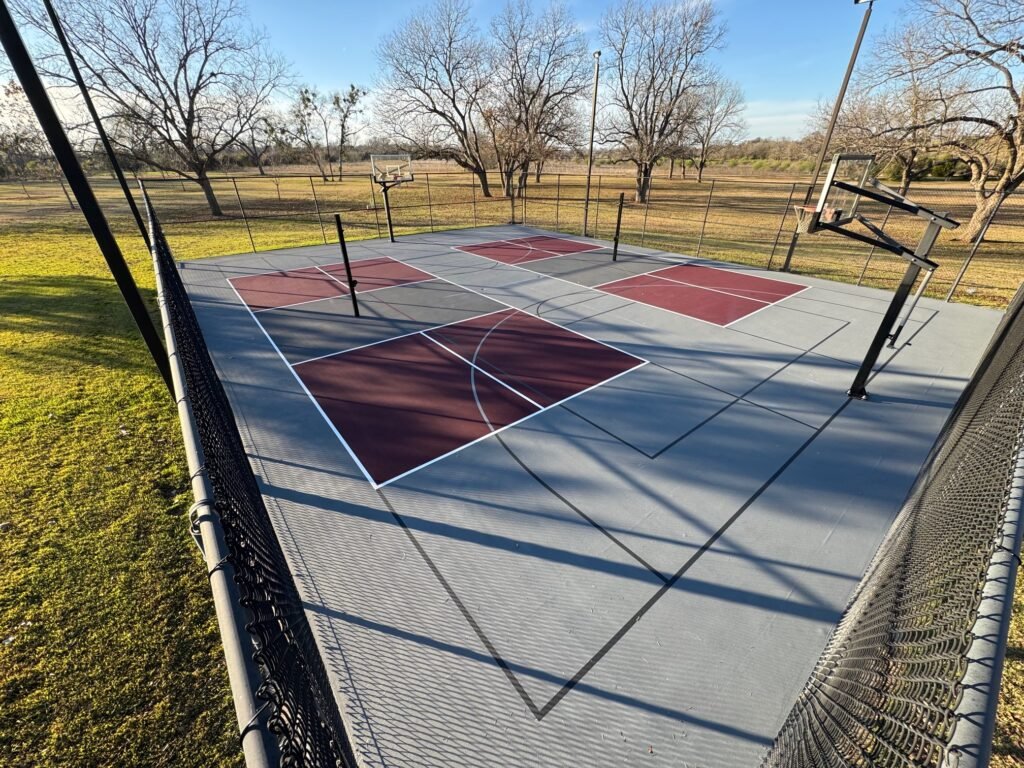
If you have ever played on a court that “looks fine” but feels off, you already know the truth. The best tennis courts are built in the parts people do not see. Grading, drainage, base work, and the little details that keep the surface stable and consistent over time.
We take those fundamentals seriously because this area gets steady use. Courts at neighborhoods, schools, and facilities see traffic, and that traffic will expose weak prep fast. We manage the build from start to finish with one team and clear communication so the project stays organized and the court turns out the way it should.
A home court in Bryan or College Station needs to match your property and your routine. Some owners want a court that ties into a pool, patio or outdoor kitchen. Others prefer a quieter setting toward the back of the lot, where play feels more private.
We take into account:
From there, we design a layout that fits the space you have and supports the way you plan to use it, whether that is regular training, relaxed evening rallies or weekend family time.
Schools, HOAs, churches and private facilities in the Bryan–College Station area need courts that handle steady use and varied skill levels. For these projects, we focus on durability, safe footing and clear, visible lines that hold up under daily play.
We also work through practical details with you, such as gate locations, fence height, windscreens and lighting so the courts are easier to supervise, maintain and schedule for teams, classes and community use.
Your surface system shapes how the court feels, how the ball responds and what kind of care it will need over time. We explain options in clear terms and relate them to your usage and local climate.
Acrylic Hard Courts
Acrylic hard courts offer a clean, familiar playing surface with a dependable bounce. They are a strong fit for lessons, league play, team practice and private home courts that want a traditional look. When installed over a well built base and maintained with quality coatings, acrylic systems handle Brazos Valley heat, sun and storms reliably.
Cushioned systems add a resilient layer beneath the surface, reducing impact on joints without creating a soft or inconsistent court. They are often chosen by players who spend many hours on court, families with wide age ranges or facilities that place extra value on comfort. You get a responsive surface with a more forgiving feel underfoot.
Color and line work are where your court can reflect its setting. We can coordinate colors with your home, school or club branding, keep lines straight and balanced and include logos or custom markings where identity matters. Whether you want subtle tones that blend with landscaping or bold school colors, we treat these details carefully so the court looks finished from day one.

Bryan and College Station see hot summers, thunderstorms, clay based soils and occasional cold snaps. Courts that ignore those conditions tend to show early wear. The difference between a court that lasts and one that struggles often comes down to what you do not see: drainage, grading, base preparation and the way the system is built up.
We begin by studying how water moves across your property today. We look at low spots, existing swales, nearby roofs and pavement and how they affect runoff. Then we design the court so water has a clear path away from the playing surface.
Good drainage helps:
Reduce standing water after storms
Protect coatings and base layers
Shorten the time between bad weather and your next match
A strong base is what supports a consistent bounce and a stable feel. In the Brazos Valley, expansive soils make this step especially important. We prepare and compact the subgrade properly, build the base to support your chosen surface system and address any soft or unstable areas before they can cause issues.
Done correctly, this helps limit dips, cracking and uneven spots that change how the ball reacts or how the court feels underfoot.
Players should move with confidence, not hesitation. We use surface systems and finishes selected for dependable traction and smooth footwork so the court feels consistent from corner to corner. The goal is simple, a surface where you can focus on the point, not on the ground beneath you.
Lighting extends playing time into the cooler parts of the day, which can be important in a university town with busy schedules and warm evenings. We design lighting layouts that support good visibility on court and sit neatly within the look of the home, campus or facility.

We evaluate the site, talk through surface options, and identify grading and drainage needs early.

We meet with you on site in Bryan or College Station, listen to how you want to use the court and study the property for slopes, drainage patterns, trees, setbacks and access.
After the visit, you receive a clear scope of work with recommended options and upgrades. The proposal outlines the layout, surface system, base and drainage approach and any additions such as fencing, windscreens or lighting, along with transparent pricing.
Once the plan is approved, our crew handles construction from base preparation through surfacing and striping. We pay attention to details that affect performance, appearance and day to day use, not only the final color.